Review 1st open session Phrases Research

Hallo everybody,

thanks so much for all the good work during the Open Session at Dansmakers on 30th of February.

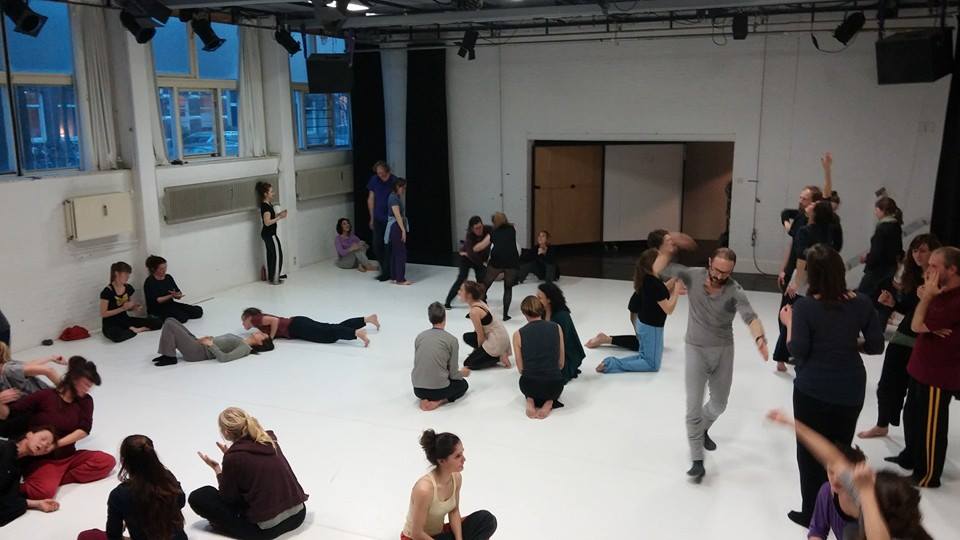
We were with 40 dancers/singers (+ 1 dog), which is an amazing number for a research session, and it worked magically, beautifully well!  The performance in the evening was surely something to remember…

I just wanted to post here the aspects of the research that we gathered during the session, with your help. The core group will now dig deeper into it the coming weeks and we hope to see you again on the rounding off Open Session on 29th of March.

phrases40people_opening

Phrase =  beginning – duration – end

Linked to the question of beginning/end in phrasing:
Landing/Arriving – What ends? – Transformation – give new life to… – what comes after? – same/different/similar thing in different context.

Linked to duration:
Coherence/Integrity of a Phrase – What holds is together? – ‘It makes sense’ – Dynamics – Shape – Rhythm

What is Silence? (in Phrasing)

Awareness of choice in Phrasing: what, when, where, with whom?

Why phrasing? For readability / For clarity of your vocabulary
Phrasing = Articulation

Phrases are Building Blocks and Markers – in time/material. Creating perspective in the sea of meanings.

What are the different layers of a phrase?     
         

More quotes that were put on the second paper at the end of the session:

“Interaction is important for phrasing/meaning.”

“For something to be a phrase you need at least two elements and a connection between them.”

“I make decisions all the time.You need to keep in mind your destination the entire road.”

“What is being proposed?” “Making a choice brings clarity and readability. Awareness of another phrase is a starting point.”

“Letting it grow, not make it”.

“10 people, many phrases. One phrase is contagious: Three people pick it up, join and finish the phrase.”

Phrase –> Receiving

“Relating in time to phrases:
– Starting together
– Slow starting after each other –
– Together: A – one phrase and B – three phrase in one”

“Timing, Dynamic, Play!” / “Connect”

To join the upcoming open session on 29th of March or read more about the project, find all information here.

secretlifeofPhrases_opening

Kick-off “Phrases” research with open session at Dansmakers today!

Today we are opening the project that will run through March in the Carpet Sessions: “The Secret Life of Phrases”

You are all very welcome to join us and the research group either in the open session and perform with us or simply come to watch the performance:

16:00-16:30  Individual Warm-Up time
16:30- 18:45  Practice session
19:00- 19:30  Joint Performance

Location: Dansmakers Amsterdam (WG terrein), Eerste Helmerstraat 102  ½ (opposite 147)
Contribution (if you join the practice session): 15 euro
Performance at 19:00 is free.

voicemovemnt3Look here for the full description of the project and here for the follow-up post.

The second open session, which will close the project, will be at Dansmakers on 29 March.

Looking forward to see you either today or in March!

Thomas Johannsen
Marisa Grande

“Secret Life of Phrases” project is set!

Dear improvisers,

Thank you for all your reactions to the “Secret Life of Phrases” research!

We had great response from a number of colleagues and heard clearly the shared intention to support and take part in these self-organized research projects under the Carpet Sessions wing. The idea is to grow in the interdisciplinary practice and feed the improvisation community in the Netherlands.
Next to this project, we trust that other events of this kind will follow and we would like to encourage other artists to feel inspired and organize such a gathering under a theme they feel strongly about.

voicemovemnt3For this particular project, we have the division between two longer, open sessions (22-02 and 29-03) and closed sessions with the core group on four Thursdays in between.

Our choice of a core group has been made considering different aspects of having a balanced and challenging configuration, as well as limiting numbers to be able to work intensely in this limited time frame. The core group is:
Sarah Kate Gardiner, Maria Michailidou, Johnny Schoofs, Marc Nukoop, Virag Dezso, Moira Mirck, Petra Pieck, Yinske Silva, Marjolijn Roeleveld

The core group will deepen the research during the Thursday Sessions, but before and after we would like to welcome everyone on the two Saturdays where the dialogue with movement and voice and a reflection with a larger group can take place.

So we are looking forward to meet you in the Secret Life of Phrases research!  See for the whole project description this post.

If you want to take part in (one of) the IC practice sessions, on Saturday 22nd of February and/or 29th of March, do let us know by commenting below, so we have an approximation of numbers.

Times and Address for the two IC Sessions:

16:30 -18.45 Practice (studio open 16.00)
19.00 -19.30 Performance

Contribution: €15,-
Address: Dansmakers Amsterdam, Eerste Helmerstraat 102 ½ (opposite 147)

voicemovement

We hope to see you there and play/reflect together! 

With warm greetings,

Thomas & Marisa

The secret Life of Phrases

voicemovementvoicemovemnt3

The secret Life of Phrases
An investigation into Voice and Movement

A musical phrase, just as a movement phrase are the DNA of any music/dance improvisation performance. They are building blocks, that combined create more complex structures of dance, composition, story…

And what are phrases themselves made of? Sounds, tones, rhythmical relationships in music, and for physical performers: smaller pieces of movements and the way they are pieced together in tension and timing.

Vocal Performers and Dancers lean into each others’ discipline quite often. As for a dancer the use of voice can be seen as just another layer of playing with the body as an instrument, while for a singer the way the voice is affecting the body (and vice versa) is an always present aspect of musical performance.

Working with phrasing means working on a higher level than just producing sounds or movement, which is to say that in instant composition performance, working with your voice or your body cannot simply stay a side-effect of your other, main register in which you improvise. Phrasing means articulating sound or movement in such a way that it takes on a full sense of language as we create.

We have two research questions to approach this subject of interdisciplinarity:

How to integrate voice and movement as an improvisation performer?

On individual level, how can the two registers/languages of voice and movement inform, stimulate and challenge each other in an articulated way? How can the two integrate towards one language?

How to integrate voice/sound and movement as an improvisation ensemble?

In an ensemble with dancers as well as singers, how can we integrate voice and movement into that “one language” that the ensemble speaks?

Marisa Grande and Thomas Johannsen want to combine their experience in order to explore these questions from both sides of the range. While being both multidisciplinary improvisers, Thomas leans probably a bit more towards musicianship through his vocal improvisation work with the Genetic Choir, Marisa comes slightly more from the perspective of movement improvisation through her somatic dance practice.

In the project that we propose, we would like to work with a small group of core-researchers: 4 improvisation singers / 4 improvisation dancers. At the same time, we will open up the research to any other improvisers who are interested to meet the research group and play together on two occasions: the IC practice+performance at Dansmakers.

The whole project is made of 2 Saturdays (open IC practice+performance), and in between 4 afternoons of research in the Carpet studio. Closing the project will be a performance at The Boiler Room in Utrecht and maybe other public gigs that will appear by that time.

Saturday 22 February – IC practice and performance at Dansmakers (16:30-20:00) – practice and performance open to all improvisers
Thursday 6, 13, 20, 27 March – research sessions in the Carpet studio – research ensemble only (14:00-17:00)
Saturday 29 March – IC practice and performance at Dansmakers (16:30-20:00) – practice session open to all / performance will be done by the research ensemble
Sunday 30 March (to be confirmed) – Performance in Het Huis Utrecht, in the Boiler Room series

The Carpet Sessions know a studio-costs share of 5 euro p.p. per session. Read more about the Carpet Sessions here.
The IC Practice on Saturdays knows a contribution of 15 euro p.p. per session to share the (higher) costs of the Dansmakers space. For this particular collaboration with the Carpet Research it will be 7,50 for the core group members to compensate for their bigger commitment.
(the money is solely to cover costs and any possible surplus will go to supporting the respective initiatives)

The project is a collaboration between the Genetic Choir, the Carpet Research and the monthly IC Practice in Amsterdam that has been initiated by Iris van Peppen and Marisa Grande.

As with all Carpet Research sessions, we are looking for performers with artistic maturity and capacity to contribute to the unfolding process from their own practice.

Please respond if you either just would like to be part of the process on one or both of the Saturdays, or if you would be interested to join the core group on all the dates and performances. We will select the core group to create an interesting mix of individuals.

Don’t hesitate to tell us you are interested, even if you still have date-issues to solve. Let us know and we will get in contact with you.

We are awaiting your reactions until 31st of December and will announce the research ensemble shortly afterwards.

Looking forward to hearing from you!

Marisa & Thomas

What’s whispering starting tomorrow!

Hiya carpeteers,

Just a reminder that this winter’s first sessions are starting tomorrow, on listening as a starting point for improvising, how to stay available while listening and not doing, what exactly are you listening to?  Etc etc etc. With some practices from my butoh and meditation journey in India the last 2 years. More info is in the first post ‘What’s whispering’. I hope to see you there, has been a while ago and would love to see some familiar faces, do write a comment to let me know if you’re ‘in’. Thanks! 

What’s whispering?

Dear carpeteers,


After a long time of studying butoh dance, vocal improvisation and meditation in India I am back in Holland and ready to share and investigate further over here…


In december I would like to explore Interdisciplinary Instant Composition through the theme of listening. Of course, we always do when performing on stage as improvisers. And there is so much to listen to.


I am curious if we can listen on a deeper level. By cutting through the loud & obvious hearing the more subtle and probably less known. By hearing the loud and choosing not to (re-) act upon it, letting it ‘borrelen’ inside until it transforms itself.


What is needed – what can we do or not do – to be able to hear the more subtle?


And how can we make the more subtle we listen to be heard by others?


Some key words:

– slowing down

– meditative states

– being moved

– silence


What are the Carpet Sessions? / Where is the studio?  (click here)


Sessions are 5, 12 and 19th of december from 13.00-17.00


Session leader is Kristien Sonnevijlle (dance/voice)


Let me know in advance if and when you can join, so that I can see how to handle group size and different disciplines. Preference goes to researchers who can do all three Thurdays. Any discipline welcome, of course. Looking forward to play with you all again…


What we experienced in the first session ‘Games of Interaction’

The first session we were only dancers and musicians and no other animals. We have been diving in to different kind of focusses how you can relate and interact with another improviser. We defined areas like space, time, speed, power/energy. Talking about those definitions made us even more aware about the difference of capability of using those areas and interpretation for a dancer or musician. To define those areas more we first worked in duo’s leading and following each other. From there every duo was designing and playing rules within the context of the specific area. When you do this, I do that….Etc etc. After every focus of area we had a short discussion about what did work and what didn’t.

1. Space: For a dancer we talked about big versus small. And on the spot versus in the space. But also a small body-part versus whole body. For some musicians a big move is creating a very different sound then a small move. For example for the double-bass. Through this the musician could relate to the dancer using the same definition and relation towards the space. But if we see a small movement affecting the space and a big movement affecting the space, we could compare this spacial effect maybe more with the volume of the sound. When you hear a very loud sound you experience it as the space being filled with lots of sound, and a soft sound stays more with the musician on the spot. Very loud would mean a big movement in space and very soft would mean a small movement on the spot.

2. Speed: The follower is following the speed of the leader.

We had the following observations:

a. Every person can have a slightly different interpretation of the rule. For example when becomes a movement so big that it isn’t small anymore? This confusion can be interesting, it gives you more space to stretch the rule. But it can also make the rule less ‘sharp’. To make a rule more sharp you can define the rule more. For example; When the dancer moves on the floor, the musician repeats his or her sound. For the musician here it means having space again. Because how long is the musical phrase that you repeat? If you wanna make the rule even more strict, you could say; When the dancer moves on the ground the musician repeats 8 counts of the sound he/she was playing.

b. When we are practicing certain strict rules it can make us as improvisers ‘narrow-minded’. We are only busy with the rule and we forget about all the other possibilities we still have. It can make our work less play-full and more flat/2-dimensional. While you are experimenting with the rules it is good to keep your awareness of the others, the space, your body using all of your senses. It is good to keep on playing. When the rule only covers a certain spacial code. You still have all freedom to play with rhythm, emotion, other improvisers etc etc.

c. We were wondering if there are also rules which are not having the ‘If-then-form’ For example: ‘If the dancer is touching another dancer with her/his hands, all improvisers do a kakafonie (chaos).’ We could design a rule of interaction which stays the whole improvisation. For example the drummers’ cymbal is following the rhythm of the knees of the dancer’. This is a very different rule. Maybe we can find other rules which are not in the ‘If-then-form’?

d. Some rules can make the dynamics of the improvisation very exciting. When the double-bass plays a very high sound, all improvisers go in to ‘chaos’. And when the sound is finished everybody goes back to where they came from.

e. We were also having games which were related to the senses, for example the eyes. When you looked in to someones eyes you had to connect to this person, and go in to the same ‘thing’. Maybe we can explore the senses more in designing new rules?

After the work in duo’s we did a group-instant-composition were we had one group-leader who could design the rules of interaction for the group. We were naming that it was even more important now that the improvisers stayed open and playful. Using the rules more to compose then as an exercise. It was wonderful to see how those rules were affecting the instant composition. They were opening the awareness of the group, creating internal relations between the improvisers, letting similar things come back in a different way.

 The 20th of June we will:
-explore more areas such as atmosphere/colour.
-we will also dive into different ways of having an interaction:
circular: When A does 1>B does 2. And when B does 2> C does 3.
group: When A does 1> whole group does 2
and I will think about more! Maybe we can also make rules which are influenced from outside. When one of the audience-members is touching his/her face all improvisers go as close as possible together, keeping on doing what they were doing.
Looking forward to see you all thursdays! I could stay longer until 17u if we are inspired to continue longer.
Greetings Maaike

Games of interaction

Dancer Maaike v.d. Westeringh is preparing an exchange project between European and Ugandan dancers and musicians. She is working in a collective that was formed out of the first project in Uganda called ‘Nasibu’. Click here if you wanna know more about Nasibu. In preparation of this dance-music-project which will happen in 2014 she would like to investigate some simple  games. Together with you, dancers, musicians and other artists she wants to play with some clear rules which are influencing the relation, sound-movement-space. We will start with one rule, finally building a game with more complex rules which will bring us out of our comfort-zone. She is interested in creating a strong interdisciplinary world where everybody influences everybody, in an endless amount of possibilities and where everybody is leader and follower at the same time.
Would be lovely to have you there! Can you let me know if you wanna come, so I know more or less which animal there is and how many 🙂
We will work thursday the 13th and 20th of June from 13-15.30. Please be ready to go at 13u, because Maaike has to leave at 15.30 sharp.
For location-details click the link below.

Tomorrow: final session on Duration/Time

Be welcome tomorrow afternoon (Thursday 2nd of May, 13:00-17:00) for the last of the three sessions we did to research the phenomenon of Duration/Time-span as it applies to interdisciplinary improvisation performance.

Look here for the original post/invitation.

You can still join the session tomorrow, just write a comment to this post to announce yourself. If you haven’t been before, do include your performance discipline, so we have an idea of the group we will work with.

See you tomorrow!

Thomas + José

What are the Carpet Sessions? / Where is the studio?  (click here)